The constellation was named by Tycho Brahe, who had no idea that behind the unremarkable, faint stars lie countless distant galaxies. It is the only constellation named after a real person.
On older Hungarian star charts, the scattered stars of Berenice's Hair were known as Tatárdúlás (Tatar Destruction). The name preserves the sad memory of the devastation caused by the Tatar armies in the 13th century.
Neighboring constellations: to the north Canes Venatici, to the west Ursa Major and Leo, to the south Virgo, to the east Boötes.
Stars
Diadem (α Comae Berenices – the name symbolizes the crown decorating the queen's head) is a double star 58 light-years from us. It consists of two main-sequence stars, both slightly hotter and brighter than the Sun. Their spectral type is F5V. Its brightness is approximately 4.32 magnitudes, making it the second brightest star in the constellation. The two stars orbit each other with a period of 26 years.
β Comae Berenices is the brightest star in the constellation with a brightness of 4.26 magnitudes. Its spectral type is G0V. The star is similar to the Sun, only slightly larger and brighter. It is approximately 30 light-years from us.
γ Comae Berenices is a star of 4.36 magnitudes at a distance of about 169 light-years from us. An orange subgiant with spectral type K1III.
R Com is a Mira-type variable star, whose brightness varies between 7.1 and 14.6 magnitudes. The period is 363 days. This is a pulsating red giant.
Deep-sky objects
The constellation contains the northern part of the Virgo Cluster of galaxies (also known as the Coma–Virgo Cluster), which is about 60 million light-years from us. It is located in the border area with Virgo, containing approximately 1500 galaxies. The Messier objects (galaxies) found here can already be observed with a smaller telescope.
Galaxies
M64 (Black Eye Galaxy) is a spiral galaxy 17.3 million light-years from us. A dust lane absorbs the light in front of the galaxy's bright nucleus, which makes it look like a black eye. Its brightness is 8.5 magnitudes, its size 10.7' × 5.1'.
M85 is a lenticular galaxy 60 million light-years away, with a brightness of 9.1 magnitudes and a size of 7.1' × 5.5'. Two supernovae and one bright red nova have been observed in it.
M88 is a spiral galaxy 131 million light-years away, with a brightness of 9.6 magnitudes and a size of 6.9' × 3.7'. One supernova has been observed in it.
M91 is a spiral galaxy located in the southern part of the constellation. It is a member of the Virgo Cluster and is approximately 63 million light-years from the Milky Way. This is one of the faintest objects in the Messier catalog, making it one of the most difficult to observe as well, with an apparent brightness of 10.2 magnitudes. Its size is 5.4' × 4.3'.
M98 is a medium-sized spiral galaxy, also a member of the Virgo Cluster, located 44 million light-years from us in the slightly northern part of the constellation. Its brightness is 10.1 magnitudes, its size 9.8' × 2.8'.
M99 (Pinwheel Galaxy) is a spiral galaxy located in the northern part of the constellation, about 45 million light-years from the Milky Way. Four supernovae have already been observed in this galaxy. Its brightness is 9.9 magnitudes, its size 5.4' × 4.7'.
M100 (Mirror Galaxy) is a starburst spiral galaxy, one of the brightest and largest galaxies in the Virgo Cluster. It is approximately 55 million light-years from our galaxy. Seven supernovae have been identified in it so far. Its brightness is 9.3 magnitudes, its size 7.4' × 6.3'.
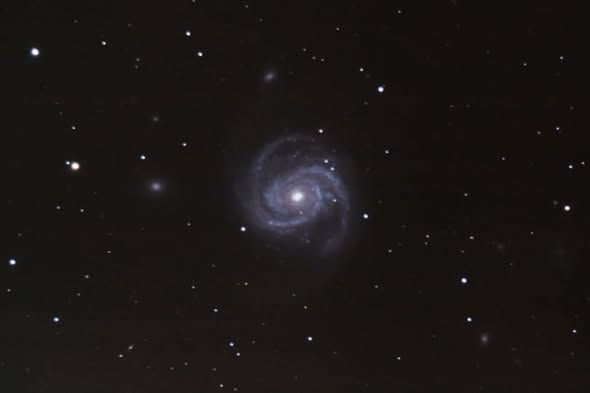
M100 - Iván Molnár, Gemini Astronomical Observatory, Negyed, SK
NGC 4565 (Needle Galaxy): a huge spiral galaxy seen edge-on, which is often compared to the Milky Way, since viewed from the right angle it might look similar to our galaxy. It is approximately 50 million light-years from us. Its brightness is 10.4 magnitudes, its size 15.9' × 1.85'. It has two companion galaxies and consists of approximately 240 globular clusters.
NGC 4889 is a giant elliptical galaxy with one of the most massive known black holes in its center (21 billion solar masses). It is one of the brightest central galaxies of the Coma Cluster of galaxies. It is approximately 308 million light-years from Earth. Due to its great distance, its brightness is 12.9 magnitudes, its size 2.9' × 1.9'.
Quasar
PG 1247 +26° – the brightest quasar in the constellation. The star-like radio sources are called quasars (from the English quasi-stellar radio source).
Globular cluster
M53 is located next to Diadem; this is the globular cluster. A small telescope is needed to observe it, because its brightness is 7.6 magnitudes and its size is large, 13', so its surface brightness is low. Its distance is 58 thousand light-years.
Open cluster
Melotte 111 (Collinder 256) is the fourth nearest star cluster, which is a moving cluster. In these clusters, the proper motion and radial velocity of the stars are roughly the same. It consists of approximately 40 stars brighter than tenth magnitude. About ten of its stars are visible to the naked eye scattered over a 7.5° area south of the star γ Com. It is visible in its entirety and beauty with binoculars.
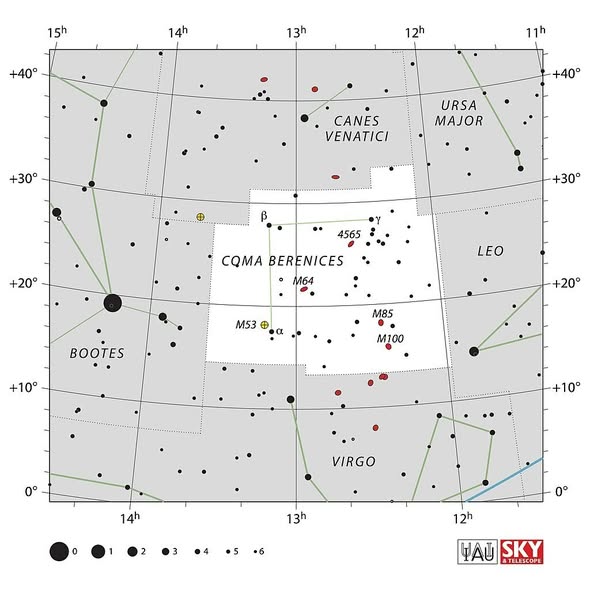
Coma Berenices constellation - IAU-Sky&Telescope
Club Member